Symmetric vs Asymmetric Encryption - Under the Hood

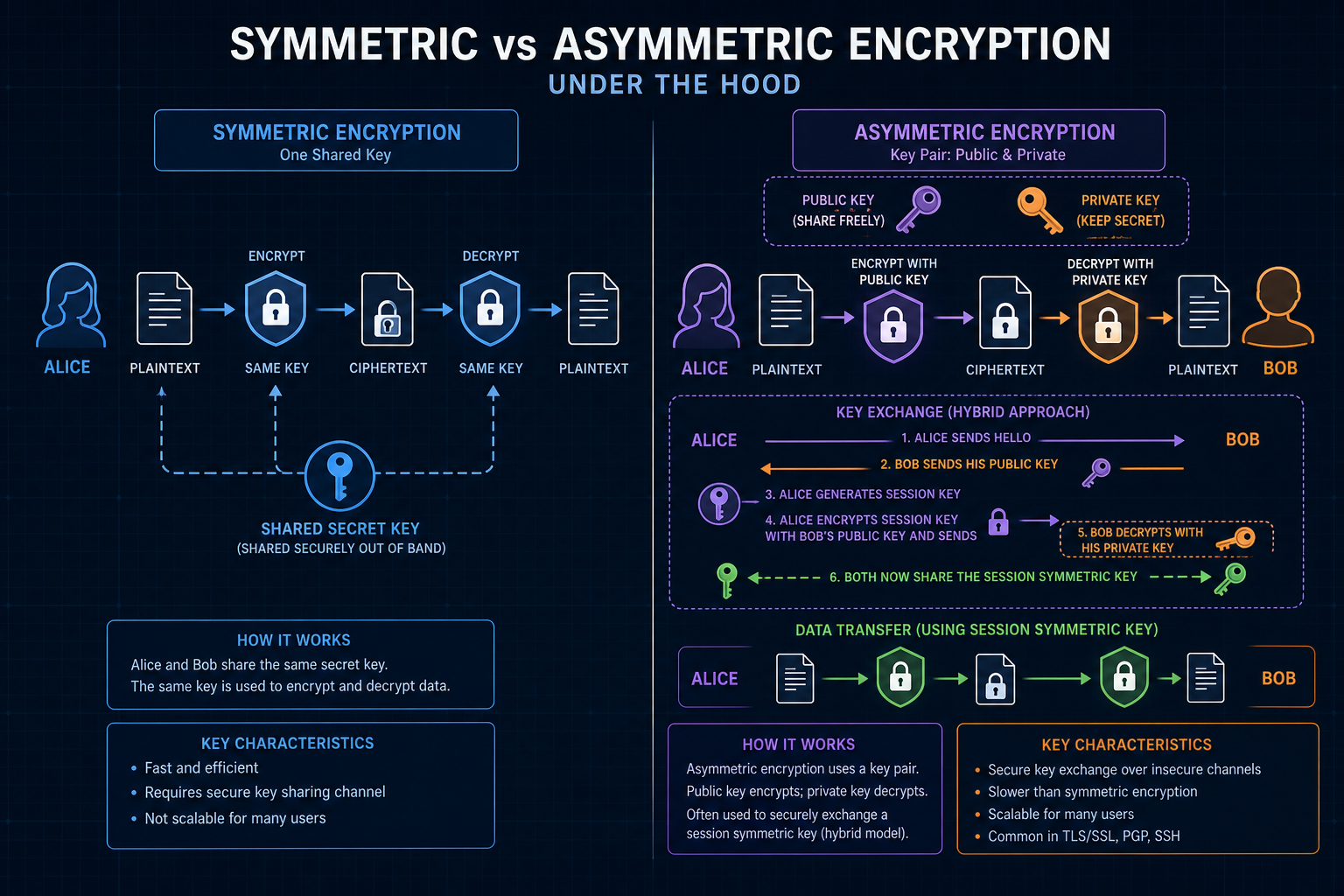
Bulk traffic is almost never encrypted with RSA directly. Trust starts with key pairs; speed runs on shared secrets.
Most engineers hear: symmetric = one key; asymmetric = public/private. Correct. Incomplete. The hard problem is usually key distribution: how do strangers share a secret without leaking it? Production systems answer with a hybrid: asymmetric (or a KEM) to authenticate and agree a secret; symmetric algorithms (AES-GCM, ChaCha20-Poly1305, …) to protect the bytes that matter at volume: TLS records, disks, database fields.
Asymmetric crypto solves key distribution and identity. Symmetric crypto solves bulk confidentiality and integrity at speed. Modern TLS, envelope encryption, and most “encrypt the API” designs are hybrids. Treating one as a full replacement for the other is the root design error.
The bottom line first
- Symmetric: same secret for encrypt and decrypt. Fast. Prefer modes that also attach a tamper seal (AES-GCM, …). Hard part: sharing and storing the secret safely.
- Asymmetric: key pair. Public key can encrypt or verify; private key decrypts or signs. Slower. Hard part: protecting the private key and trusting the public key.
- The real question is not “which is more secure.” It is key size, algorithm choice, and how you store and distribute keys. A leaked AES key loses; a leaked RSA private key loses.
- Encrypt ≠ sign. Encryption hides content. Signatures prove origin/integrity. Different keys, different goals.
- TLS / HTTPS: handshake uses asymmetric (certs + ECDHE/KEM) to set up trust; record protection uses symmetric session keys.
- At rest: often a data key (symmetric) wrapped by a KMS master key (asymmetric or HSM-backed).
- Pick by problem: shared secret channel you control → symmetric; bootstrap trust over an open network → asymmetric + PKI (then switch to symmetric).
What they actually are
- Symmetric
- Asymmetric
Same secret on both sides. Alice encrypts with K; Bob decrypts with K.
Alice encrypts with Bob’s public key; only Bob’s private key opens it.
| Symmetric | Asymmetric | |
|---|---|---|
| Keys | One shared secret | Public + private pair |
| Key distribution | Must share K safely (or derive / unwrap it) | Public key can be published; private key never travels |
| Speed | Fast for large data | Slower; used on small secrets / signatures |
| Typical key size | 128 or 256-bit (e.g. AES) | Much longer (e.g. RSA 2048+) or shorter ECC keys with hard math |
| What you get | Confidentiality + integrity when you use AEAD | Confidentiality (encrypt to a recipient), authenticity, non-repudiation (sign) |
| Main job | Protect streams/blobs once keys exist | Authenticate, sign, wrap keys, agree keys |
| Examples (use these) | AES-GCM, ChaCha20-Poly1305 | RSA, ECDSA, ECDH/ECDHE, ML-KEM (post-quantum emerging) |
| Legacy (avoid for new work) | DES, 3DES, RC4, IDEA | Weak RSA sizes, broken padding modes |
Symmetric wins on bulk bytes. Asymmetric wins on who holds which secret over an open network. Production systems almost always use both.
Components involved
The building blocks. Plain versions:
| Piece | What it is | Symmetric | Asymmetric |
|---|---|---|---|
| Key / key pair | The secret the math runs on | One shared secret both sides know (like a house key both roommates have). Anyone with K can read | A pair: public (ok to share) + private (must stay secret). Public is like a padlock others can lock; private is the key that opens it |
| Block vs stream | How plaintext is chopped for the cipher | Block (AES: fixed-size chunks) or stream (ChaCha: continuous). Prefer modern AEAD modes | Not the main mental model; you usually encrypt small blobs or run a handshake, not stream a whole disk with RSA |
| Tamper check (auth tag) | A short seal computed with the key and glued to the ciphertext | Modern modes (AES-GCM, ChaCha20-Poly1305) encrypt and seal in one step (AEAD). Bob recomputes the seal; if it does not match → someone changed the bytes → reject. Not a signature; same shared K | Cousin is a signature: proves who wrote it, not only that it was unchanged |
| Nonce / IV | A one-time random number sent with each encrypted message (usually not secret) | Required with AEAD: same key + same nonce twice can leak data. Fresh nonce every message | Not used the same way for “encrypt to Bob.” Signing has its own reuse rules |
| Key agreement | How strangers get a shared secret without mailing K | After agreement, both hold the same session key | ECDHE / Diffie-Hellman-style math (often inside TLS). Different from “RSA-encrypt the file” |
| Certificate | A signed document that binds a public key to a name | Not used. You already shared the secret somehow | “This public key belongs to api.example.com,” backed by a trusted CA. What browsers check for HTTPS |
| KMS / HSM | Safe place to keep keys so apps do not hardcode secrets | Often stores or wraps data encryption keys | Often guards the private or master key so it is hard to extract |
How a flow works
Same building blocks as Components involved above. Each swim lane labels which pieces show up.
- Symmetric
- Asymmetric
Uses: shared key, nonce/IV, tamper check (auth tag), optional KMS. Not used: certificate. Key agreement (if any) already happened; both sides hold K.
- Key: same shared secret
Kon both sides (already shared, KDF, or KMS). - Nonce / IV: fresh one-time random for this message.
- Encrypt (block or stream AEAD): plaintext → ciphertext plus tamper check (auth tag).
- Send ciphertext + tamper check + nonce. Peer verifies the seal, then decrypts with
K.
A key pair does two different jobs. Mixing them is the classic crypto mistake.
| Job | Question it answers | What you do | Which key |
|---|---|---|---|
| Secrecy (confidentiality) | Can only Bob read this? | Encrypt (usually a small DEK) | Bob’s public lock; Bob’s private unlock |
| Authenticity (origin + integrity) | Did Alice write this, unchanged? | Sign a hash | Alice’s private seal; Alice’s public check |
Secrecy hides content. Think of locking a box with Bob’s padlock (his public key). Anyone can snap the padlock shut. Only Bob has the key that opens it (his private key). In practice you lock a small DEK, then encrypt the big file with that DEK (envelope).
Authenticity does not hide content. Think of a wax seal on a letter: everyone can read the letter; the seal shows it came from Alice and was not rewritten. Alice seals with her private key; Bob (or anyone) checks with her public key, usually after trusting that public key via a certificate.
Secrecy steps
- Bob publishes his public key; private key stays with Bob (KMS/HSM if hardened).
- Alice encrypts a small DEK with Bob’s public key, then encrypts the file with the DEK.
- Only Bob unlocks the DEK with his private key → only Bob reads the file.
Authenticity steps
- Alice hashes the message and signs the hash with her private key.
- She sends message + signature (the message itself can stay readable).
- Bob trusts Alice’s public key via a certificate (or already knows it), then verifies.
- Match → Alice’s key and untampered. Fail → wrong person, wrong key, or change.
Key agreement (ECDHE) is a third job: strangers derive a shared session key without shipping K. After that, the Symmetric tab applies for bulk bytes.
| Goal | Component | Which key |
|---|---|---|
| Secrecy: encrypt for Bob | Key pair | Bob’s public |
| Secrecy: decrypt | Key pair / KMS | Bob’s private |
| Authenticity: sign | Signature | Alice’s private |
| Authenticity: verify | Signature + certificate | Alice’s public |
Common myth: “encrypt with private, decrypt with public.” That is authenticity (signing), not secrecy. Signing uses your private key; encrypting for someone uses their public key.
Symmetric moves bulk bytes. Asymmetric moves trust and small secrets. Glue them with envelope encryption or a TLS-style handshake.
Where each is used
| Surface | Symmetric | Asymmetric |
|---|---|---|
| HTTPS / TLS records | Session keys protect Application Data | Certs + key agreement (ECDHE, …) set up those keys |
| SSH | Session encryption after auth | Host keys / user keys authenticate |
| JWT | HS256 (shared secret HMAC) | RS256 / ES256 (sign with private, verify with public) |
| Disk / DB / file encryption | DEK encrypts data (AES) | KMS wraps DEK with master key |
| VPN / IPsec / WireGuard | Session crypto | Identity and handshake material |
| mTLS | Symmetric after handshake | Client and server certs prove identity |
| Secure email / document signing | Optional body encryption via hybrid | Signatures and cert chains |
| Code / firmware signing | Rarely the outer model | Signatures and cert chains |
For one HTTPS call by phase (TCP → handshake → session keys → AEAD records), see HTTPS Encryption Lifecycle Under the Hood.
Hybrid pattern (envelope encryption)
Big files use fast symmetric crypto. Asymmetric / KMS only protects a small key, not every byte. Same hybrid idea as TLS: handshake or wrap is expensive; bulk traffic is AES (or ChaCha).
- Make a random DEK (symmetric).
- Encrypt the data with that DEK.
- Encrypt (wrap) the DEK with the master key in KMS.
- Store: encrypted data + locked DEK.
Steal the disk → you get both blobs, but not the master key → you cannot unlock the DEK → data stays unread. Same idea as TLS: slow crypto sets up keys; fast crypto moves the bytes.
Use cases: how to choose
| Need | Prefer | Why |
|---|---|---|
| Encrypt high-volume traffic, disks, or large files | Symmetric (after keys exist) | Performance |
Prove a server is api.example.com on the open internet | Asymmetric + PKI certs | Public verifiable without a pre-shared secret per client |
| Two services in one VPC that already share a secret | Symmetric (or mTLS if you want identity beyond a string secret) | Simpler ops if secret distribution is solid |
| Non-repudiation / artifact signing | Asymmetric signatures | Private key implies signer |
| Rotate data keys often without re-encrypting the world | Envelope (new DEK, re-wrap) | Ops flexibility |
| Browser ↔ public API | TLS hybrid (do not invent your own) | Use the platform |
| “Which is more secure, symmetric or asymmetric?” | Wrong question | Ask: algorithm + key length + who holds keys + how keys move |
Failure modes
| Mistake | What goes wrong |
|---|---|
| Reuse nonce/IV with same AES-GCM key | Catastrophic confidentiality/integrity failure |
| “Encrypt with private key” for secrecy | Wrong primitive; you wanted sign or recipient public encrypt |
| “Asymmetric is always more secure” | Ignores key custody; a leaked private key or weak RSA size still loses |
| Ship private key in the app binary | Anyone extracts trust |
| Trust-all / disable hostname verify | HTTPS becomes cleartext theater |
| One long-lived symmetric key for everything | Blast radius = entire estate |
| Asymmetric-encrypt huge payloads | Latency, size limits, wrong design |
| Keep DES / 3DES / RC4 in new systems | Broken or withdrawn; use AES-GCM or ChaCha20-Poly1305 |
Why it still matters
Service meshes, KMS, JWT libraries, and TLS terminate in different places. Architects must say which key, who holds it, and which algorithm class protects data in transit vs at rest. Compliance questionnaires ask that; so do real incidents.
Ask: where is the private/master key, how is the DEK wrapped, and does TLS terminate before the data is “safe”? If vague, crypto is unowned.
Final takeaway
Symmetric cryptography is the workhorse for bytes. Asymmetric cryptography is the workhorse for trust and key bootstrap. HTTPS, SSH, and envelope encryption succeed because they use both. Design the hybrid on purpose; do not pick a side like a sports team.