HTTP vs HTTPS - Under the Hood

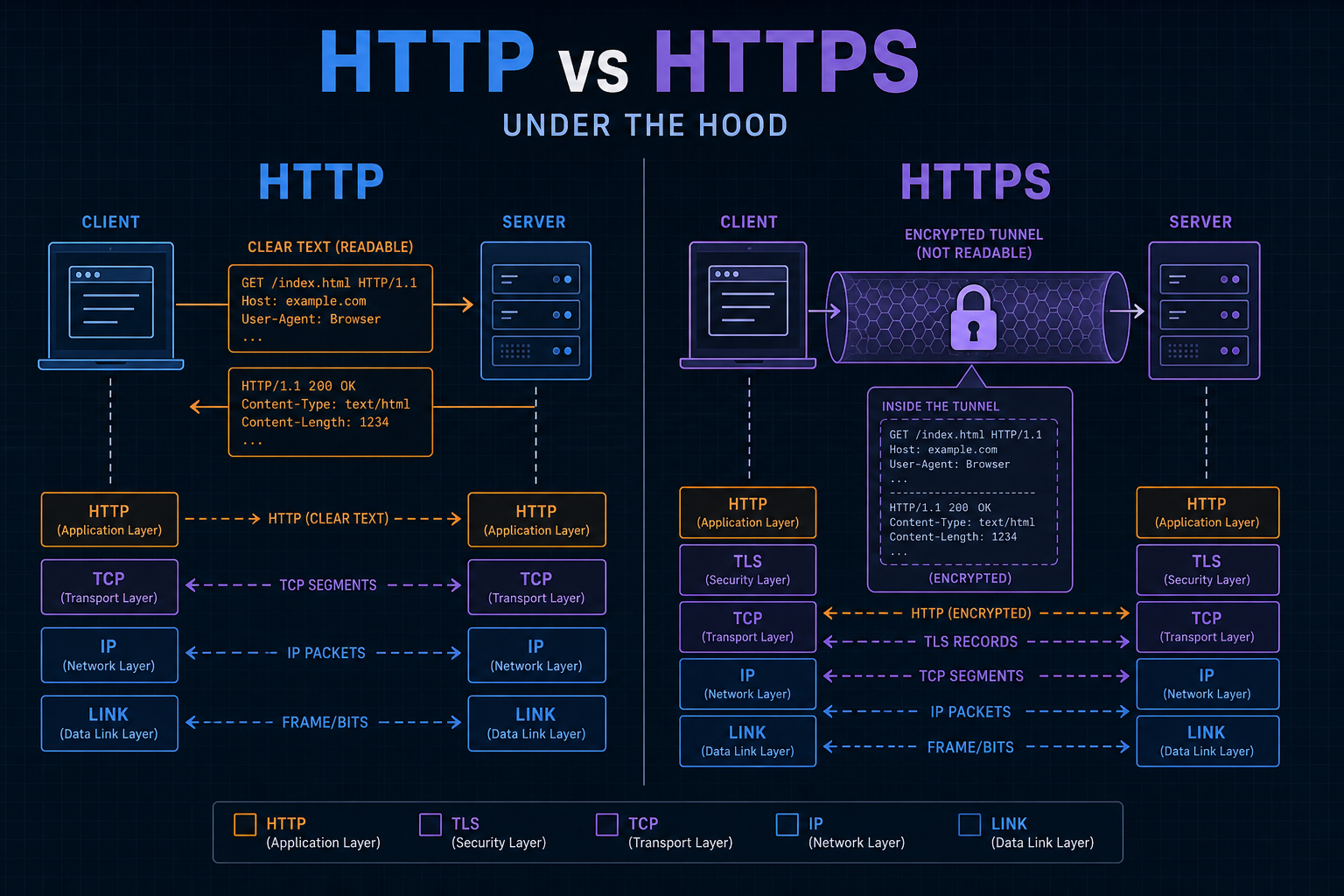
The padlock is not a different web language. It is the same HTTP messages riding inside a cryptographic channel.
Most engineers know: HTTP is plain; HTTPS is secure. That slogan skips the layering. HTTP defines request/response. HTTPS means those bytes travel over TLS (usually on TCP :443, or inside QUIC for HTTP/3). Misread that boundary and you debug TLS alerts as “the API is down” or treat HTTP 500 as a certificate problem.
HTTPS is HTTP over TLS, not a separate application protocol. HTTP still owns method, path, status, and headers. TLS owns confidentiality, integrity, and (usually) server authentication before those bytes move.
The bottom line first
- HTTP (Layer 7): request/response messages; methods, status codes, headers, optional body.
- HTTPS: same HTTP messages inside a TLS session (encrypt + integrity + server auth via certificates in the common case).
- Ports: cleartext often
:80; TLS-wrapped often:443(convention, not magic). - Stack: HTTP → (TLS) → TCP or QUIC → IP. HTTP/3 = HTTP over QUIC (UDP), still “HTTPS” in the browser sense.
- Cleartext HTTP exposes URLs, headers, and bodies to the path. HTTPS hides them from casual observers; the IP/SNI story is more nuanced.
- Observability: separate TCP failure, TLS handshake failure, and HTTP status. They are different layers.
What HTTP and HTTPS actually are
| HTTP | HTTPS | |
|---|---|---|
| What it is | Application protocol | HTTP + TLS channel |
| On the wire | Readable ASCII/text (HTTP/1.x) or binary frames (H2) in clear | Encrypted TLS records; HTTP inside after decrypt |
| Typical port | 80 | 443 |
| Server proof | None by default | Certificate validated against trust store (usual browser/API client mode) |
Components involved
| Piece | Role | HTTP | HTTPS |
|---|---|---|---|
| URL / URI | Scheme + host + path + query | http://… | https://… |
| Request line | Method + path + version | Yes | Same (inside TLS) |
| Headers | Metadata (Host, Content-Type, cookies, …) | Clear on path | Encrypted in transit |
| Body | Optional payload | Clear | Encrypted |
| Status line | Version + code + reason | Yes | Same inside TLS |
| TLS | Handshake, keys, records | Absent | Required for “HTTPS” |
| Certificate | Binds public key to hostname(s) | N/A | Server presents; client verifies |
What sits in an HTTP message
Minimal request:
Example HTTP request (cleartext shape)
GET /health HTTP/1.1
Host: api.example.com
Accept: application/json
Connection: close
Minimal response:
Example HTTP response (cleartext shape)
HTTP/1.1 200 OK
Content-Type: application/json
Content-Length: 16

{"status":"ok"}
| Part | Example | Meaning |
|---|---|---|
| Method | GET, POST, PUT, DELETE | Intent (safe vs unsafe methods matter for caches and CDNs) |
| Path | /health | Resource on the host |
| Host | api.example.com | Which virtual site on a shared IP |
| Status | 200, 404, 502 | Outcome after transport succeeded |
| Body | JSON, HTML, empty | Application data |
HTTPS uses the same message shape. A packet capture on the wire shows TLS records, not this ASCII, until you decrypt with keys.
Start to finish: HTTP vs HTTPS on the wire
Teaching TCP ports: client :53122, server :80 or :443.
Cleartext HTTP (no TLS)
Anyone on the path who sees TCP payloads can read GET /health and the JSON body.
HTTPS (HTTP inside TLS on TCP)
| Phase | What you see on the wire | HTTP visible? |
|---|---|---|
| 1 TCP handshake | SYN / SYN-ACK / ACK | No |
| 2 TLS + data transfer | ClientHello, cert, key share, then TLS Application Data records | Only after decrypt |
| 3 TCP teardown | FIN / ACK, TLS close_notify (typical) | N/A |
SNI (Server Name Indication) often appears in ClientHello in cleartext (or encrypted in newer TLS modes with limits). Hostname privacy is not absolute just because you said HTTPS.
Same HTTP. Different path protection. Debug with the layer that failed: TCP connect, TLS handshake, or HTTP status.
Certificates and trust (HTTPS)
| Idea | Meaning |
|---|---|
| Certificate | Document: public key + identity (SAN/CN hostnames) + issuer signature |
| Trust store | Set of CA roots the client trusts |
| Chain | Server cert → intermediate(s) → root the client already trusts |
| Hostname check | Name in the URL must match a name on the cert |
Common breaks: expired cert, wrong hostname, incomplete chain, private CA not in the trust store (common in enterprises), clock skew.
Companion depth: Symmetric vs Asymmetric Encryption Under the Hood explains why certs use public keys and why bulk traffic uses symmetric session keys. For one full call from TCP open through handshake and encrypted Application Data, see HTTPS Encryption Lifecycle Under the Hood.
HTTP versions (short map)
| Version | Transport habit | Note |
|---|---|---|
| HTTP/1.1 | TCP; text messages; keep-alive | One request at a time per connection (usual); pipelining rare |
| HTTP/2 | TCP; binary frames; multiplex streams | Still TLS in browsers for “HTTPS” |
| HTTP/3 | QUIC over UDP; TLS 1.3 integrated | Same origin “https://”; different lower layer (see TCP vs UDP Under the Hood) |
Use cases
| Situation | Prefer | Why |
|---|---|---|
| Public websites / APIs | HTTPS | Confidentiality + server auth expected |
| Browser apps | HTTPS | Cookies, tokens, mixed-content rules |
| Internal health on loopback | Sometimes HTTP | Local only; still prefer HTTPS in shared networks |
| Legacy device talking cleartext | HTTP only if unavoidable | Isolate; do not expose to the internet |
| HTTP/3 rollout | HTTPS on QUIC | Need UDP allowed on path |
Failure modes (wrong layer blame)
| Symptom | Often really | Not first |
|---|---|---|
| Browser “Your connection is not private” | Cert / trust / hostname / clock | App business logic |
SSLHandshakeException / TLS alert | Protocol/cipher/cert mismatch | HTTP 500 |
Connection refused / timeout | TCP / firewall / DNS | HTTPS vs HTTP scheme alone |
HTTP 502 / 503 | Upstream/app after TLS OK | “TLS is broken” |
Works on :80, fails on :443 | Cert or TLS config | “HTTP methods wrong” |
Why it still matters
CDNs, API gateways, and service meshes terminate TLS and speak HTTP upstream. You must know where TLS ends. Observability that only logs HTTP status after a mesh will miss handshake failures at the edge.
Ask: where does TLS terminate, what names are on the cert, and is the client trusting the right store? If you cannot answer, HTTPS is unowned.
Final takeaway
HTTP is the language of requests and responses. HTTPS is that language spoken inside a TLS tunnel. Ports and versions change; the split stays: HTTP semantics above, cryptography below. Design and debug each layer on purpose.