Netflix Video Processing Pipeline: From Studio Upload to Global Streaming

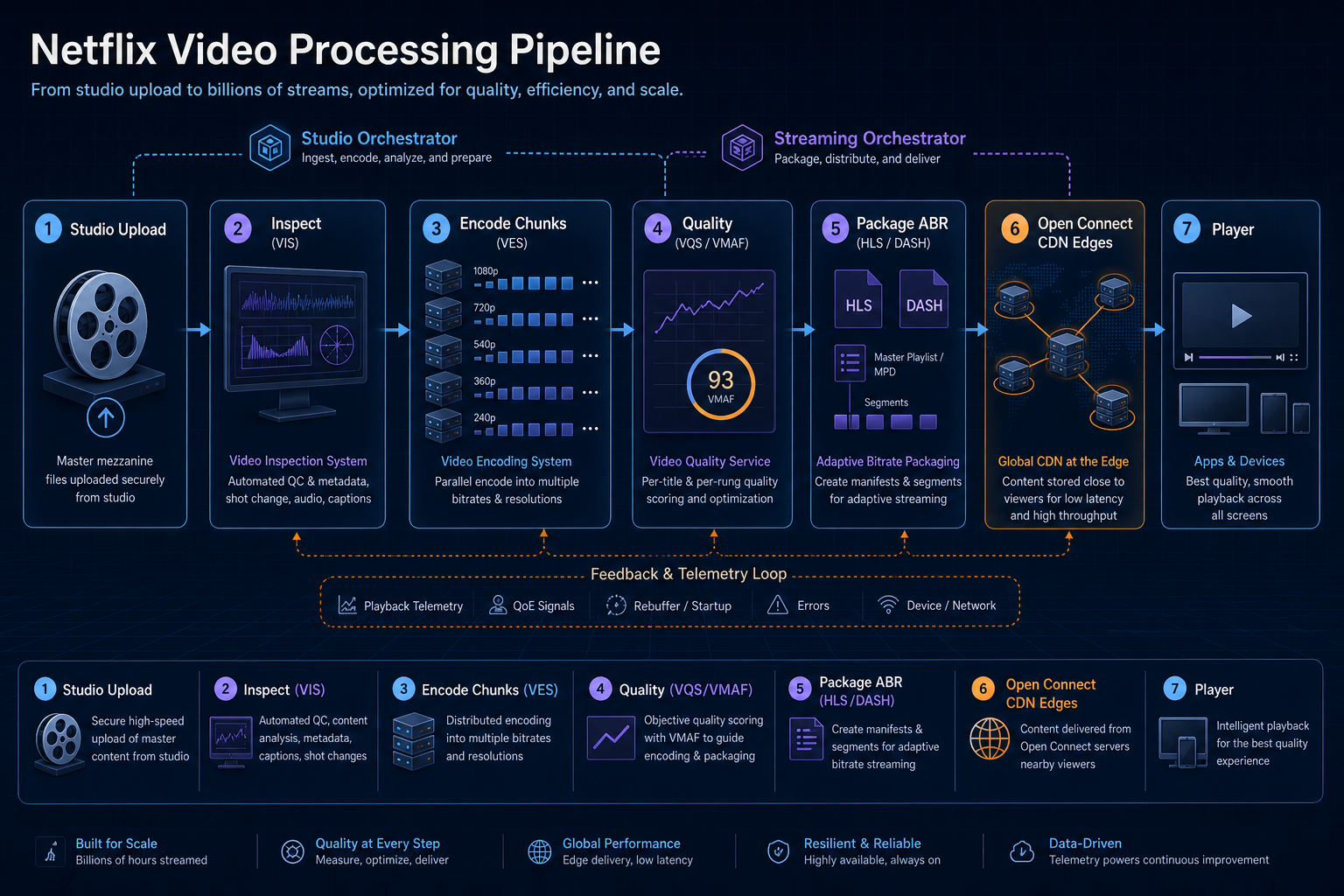
A title does not become streamable when someone clicks Upload. It becomes streamable when a media factory turns one mezzanine into many adaptive streams, measures quality, packages segments, and pre-positions bytes at the edge of the Internet.
Most system-design interviews stop at "encode and put it on a CDN." That skips the hard parts Netflix published about in the open: service boundaries for inspect vs encode vs quality, two orchestrators (studio latency vs streaming perfection), chunked parallel encoding, and a purpose-built CDN (Open Connect) that treats pre-positioning as part of the pipeline, not an afterthought.
This is an architecture breakdown of that path, grounded in Netflix Engineering's Cosmos / VES / Open Connect material. Exact internal names and topologies evolve; the design lessons stay useful.
Studio upload and member streaming are different products that share media services. Cosmos splits the work into focused microservices (inspect, encode, quality, …). Dual workflow orchestrators customize latency vs quality. Open Connect turns finished assets into a global hit path. The pipeline is the product, not a single encoder binary.
Pipeline at a glance
| # Component | What it does | Failure if skipped |
|---|---|---|
| 1. Ingest (mezzanine / IMF) | Accept the high-quality studio source package | Garbage in, expensive garbage out |
| 2. VIS (Video Inspection Service) | Validate conformance and basic source quality | Bad masters pollute every ladder rung |
| 3. VES (Video Encoding Service) | Chunked parallel encode into codec/bitrate ladders | Latency and cost explode; devices cannot adapt |
| 4. VQS (Video Quality Service) | Score encodes (e.g. VMAF); feed analytics | Blind bitrates; bad viewer experience |
| 5. Packaging | Segment + manifest for HLS/DASH (plus audio/text) | Players cannot switch quality |
| 6. Open Connect (OCA edges) | Pre-position assets; serve ABR near the member | Origin melts; startup and rebuffer suffer |
| 7. Player | ABR: pick the next chunk from buffer and bandwidth | No playback or constant rebuffer |
From Reloaded to Cosmos
Netflix's earlier media stack (often discussed as Reloaded) concentrated a lot of video work in a large, tightly coupled system. That model struggles when you need independent release cadence for codecs (stable AVC vs fast-moving AV1), different SLOs for studio vs streaming, and elastic compute for bursty encode farms.
Cosmos is Netflix's media microservice platform direction: small services with clear functions, messaging between layers, and continuous delivery for encoding tools. Encoding itself became VES (Video Encoding Service); quality measurement became VQS (Video Quality Service); inspection and ladder/recipe helpers sit beside them rather than inside one monolith.
| Monolith pressure | Microservice response |
|---|---|
| One release train for every codec | Codec-specific compute functions that can ship independently |
| Same workflow for proxy and member stream | Dual orchestrators with different optimization goals |
| Encode + quality tangled | VES vs VQS with explicit contracts |
| Hard to scale burst encode | Elastic chunk workers (Stratum-style compute) |
Treat published Netflix names (Cosmos, VES, VQS, Open Connect) as reference architecture vocabulary. Your org will rename services; keep the boundaries: inspect, encode, measure, package, place, play.
1-2. Ingest and inspection
What arrives from the studio
Upstream of streaming sits a mezzanine: a high-quality source package (often IMF / studio interchange style), not a phone upload. That asset is the root of every later encode. Metadata, audio stems, and timed text may arrive on parallel tracks.
Why inspect before encode
Video Inspection Service (VIS)-class steps extract metadata and reject non-conformant or obviously bad sources. Encoding is expensive. Discovering a corrupt master after burning thousands of chunk-hours is a systems failure, not an encoder bug.
| Check class | Examples |
|---|---|
| Conformance | Expected formats, tracks, timing |
| Sanity quality | Gross defects that should never enter the ladder |
| Identity / lineage | Which title, which cut, which version |
Studio paths may also need forensic watermarking or timecode / text burn-in for production review. Those features belong on the studio orchestrator path, not on every member-streaming encode.
Dual workflow orchestrators
Purpose in one line: two different people need video processed for two different jobs, so Netflix uses two managers (orchestrators) over the same kitchen (VIS, VES, …).
| Who is waiting? | What they need | Which orchestrator |
|---|---|---|
| Production team on set | A rough cut today so they can plan tomorrow's shoot | Studio |
| Members watching at home | Best possible quality on every device, ready for the CDN | Streaming |
If you force one workflow for both:
- Studio waits hours for member-grade ABR ladders they do not need yet.
- Or streaming ships half-baked encodes because the pipeline was tuned for speed.
So Netflix split the recipe / order of steps, not the encode service itself.
| Studio orchestrator | Streaming orchestrator | |
|---|---|---|
| Goal | Speed | Quality and completeness |
| Calls | Mostly VIS + VES (simple recipes) | VIS, ladder/recipe choice, VES, VQS, audio/text, packaging |
| Output | Editorial proxy, marketing clip, watermarked review copy | Full ABR streams for Open Connect |
| Extra features | Watermarking, timecode burn-in | Quality scores, analytics, CDN-ready package |
Analogy: one restaurant kitchen (VES). Lunch rush orders a quick sandwich (studio). Dinner service orders a full tasting menu with wine pairing (streaming). Same cooks; different tickets.
3. Encoding at scale (VES)
Chunked parallel encoding
A two-hour title is not one serial encode. The mezzanine is split into chunks, encoded in parallel across an elastic worker pool, then assembled into streams. Parallelism is how burst catalogs and new codec experiments finish in human-relevant time.
VES layered design (published shape)
Netflix described VES roughly as three layers:
| Layer | Role |
|---|---|
| Optimus | API / request edge for encode jobs |
| Plato | Workflow orchestration (DAG of media steps) |
| Stratum | Serverless-style compute running encoder containers |
Messaging between layers (e.g. Timestone-class bus) keeps API, workflow, and compute releaseable on different clocks. Codec-specific Stratum functions let AV1 churn without destabilizing AVC.
Codecs and ladders
Member devices need a ladder: multiple resolutions/bitrates and often multiple codecs (AVC, VP9, AV1, …). Recipe / ladder generation services (discussed alongside LGS-style optimization) choose where to spend bits before VES burns CPU/GPU.
| Concern | Design implication |
|---|---|
| Device diversity | Many encodes per title, not one "master MP4" |
| Network diversity | ABR segments; player switches rungs |
| Codec maturity | Isolate encoder binaries behind stable service APIs |
4. Quality as a first-class service (VQS)
Encoding without measurement is hope. VQS scores encodes and feeds Netflix data pipelines for monitoring and analytics. VMAF (Video Multi-Method Assessment Fusion), which Netflix open-sourced, is widely used as a perceptual quality metric in this ecosystem.
| Quality loop | Purpose |
|---|---|
| Per-encode scores | Catch bad rungs before wide deployment |
| Aggregate analytics | Compare recipes, codecs, and regressions |
| Feedback into recipes | Spend bits where viewers notice |
Separating VES (make bits) from VQS (judge bits) keeps innovation on encoders from blocking innovation on metrics.
5. Audio, timed text, and packaging
Video is only one plane. Streaming orchestrators also drive:
- Audio encodes and language variants
- Timed text (subtitles, captions)
- Packaging that containerizes media into player-ready HLS and/or DASH segments and manifests
Adaptive bitrate streaming means the player fetches short segments (often a few seconds) and can change quality between segments as bandwidth changes. Packaging is the contract between the encode farm and every device client.
6. Global delivery: Open Connect
After packaging, members should not pull every byte from a single origin region. Netflix's Open Connect CDN places Open Connect Appliances (OCAs) deep in ISP networks and pre-positions popular titles so playback is mostly a local hit.
That is the same control-plane idea as a general CDN (cache key, TTL, edge vs origin), with a content business that can predict and push catalogs. For the generic edge mechanics, see CDN Under the Hood. Name → edge IP still starts with DNS.
| Delivery concern | Pipeline implication |
|---|---|
| Hit ratio | Encode/package complete before fill windows |
| Catalog bursts | Elastic encode + scheduled pre-position |
| Global footprint | Multi-codec ladders matched to device maps |
Design lessons (what to steal)
| Lesson | Why it matters |
|---|---|
| Split studio vs streaming orchestrators | Fast review for production ≠ full ABR for members; share VES, not one workflow |
| Inspect before you burn encode spend | Fail fast on bad mezzanines |
| Chunk + assemble | Parallelism is the scalability primitive |
| Quality is a service | Metrics must evolve independently of encoders |
| Package for ABR, not for a single file | Players adapt; origins should not |
| CDN is part of the pipeline | Pre-positioning is a release step, not ops folklore |
| Isolate codec compute | Fast-moving codecs need independent deployability |
Where teams go wrong copying this
| Mistake | Why it hurts |
|---|---|
| One workflow for proxy and production stream | Studio latency fights streaming quality gates |
| Monolithic "media platform" release | AV1 experiment freezes AVC hotfixes |
| No perceptual quality gate | Bitrate ladders optimized for file size, not eyes |
| CDN bolted on after encode | Launch day origin storms |
| Treating packaging as an afterthought | Great encodes that no player can switch across |
From studio upload to global streaming is a staged media factory: inspect → encode in chunks → measure quality → package ABR → pre-position at the edge → let the player adapt. Netflix's Cosmos story is less about a brand-name encoder and more about boundaries, dual SLOs, and delivery as a first-class stage.
Further reading
Primary sources from Netflix Engineering and related docs. Start here if you want the original design write-ups behind this case study.
Pipeline and Cosmos
| Resource | Why read it |
|---|---|
| Rebuilding Netflix Video Processing Pipeline with Microservices | Overview: Reloaded → Cosmos, VIS / VES / VQS, studio vs streaming orchestrators |
| The Making of VES | Deep dive: Optimus / Plato / Stratum, chunked encode, Timestone |
| The Netflix Cosmos Platform | Platform model: orchestrated functions, Tapas / Sagan-style higher-level workflows |
Quality (VMAF)
| Resource | Why read it |
|---|---|
| Toward A Practical Perceptual Video Quality Metric | Why VMAF exists and how Netflix thinks about perceptual quality |
| Netflix/vmaf on GitHub | Open-source VMAF toolkit and docs |
Delivery (Open Connect)
| Resource | Why read it |
|---|---|
| Open Connect Overview (PDF) | Official overview of OCAs, control plane, and pre-positioning |
| Open Connect site | Partner-facing docs and program entry point |
| Driving Content Delivery Efficiency Through Classifying Cache Misses | How Netflix reasons about edge hit/miss and steering |
| Netflix content distribution through Open Connect (APNIC) | Clear ISP/OCA steering walkthrough |
Related (live and playback)
| Resource | Why read it |
|---|---|
| Behind the Streams: Live at Netflix (Part 1) | How live differs from VOD encode → Open Connect |
| Netflix Live Origin | Cloud origin between live packager and Open Connect |