DNS - Under the Hood

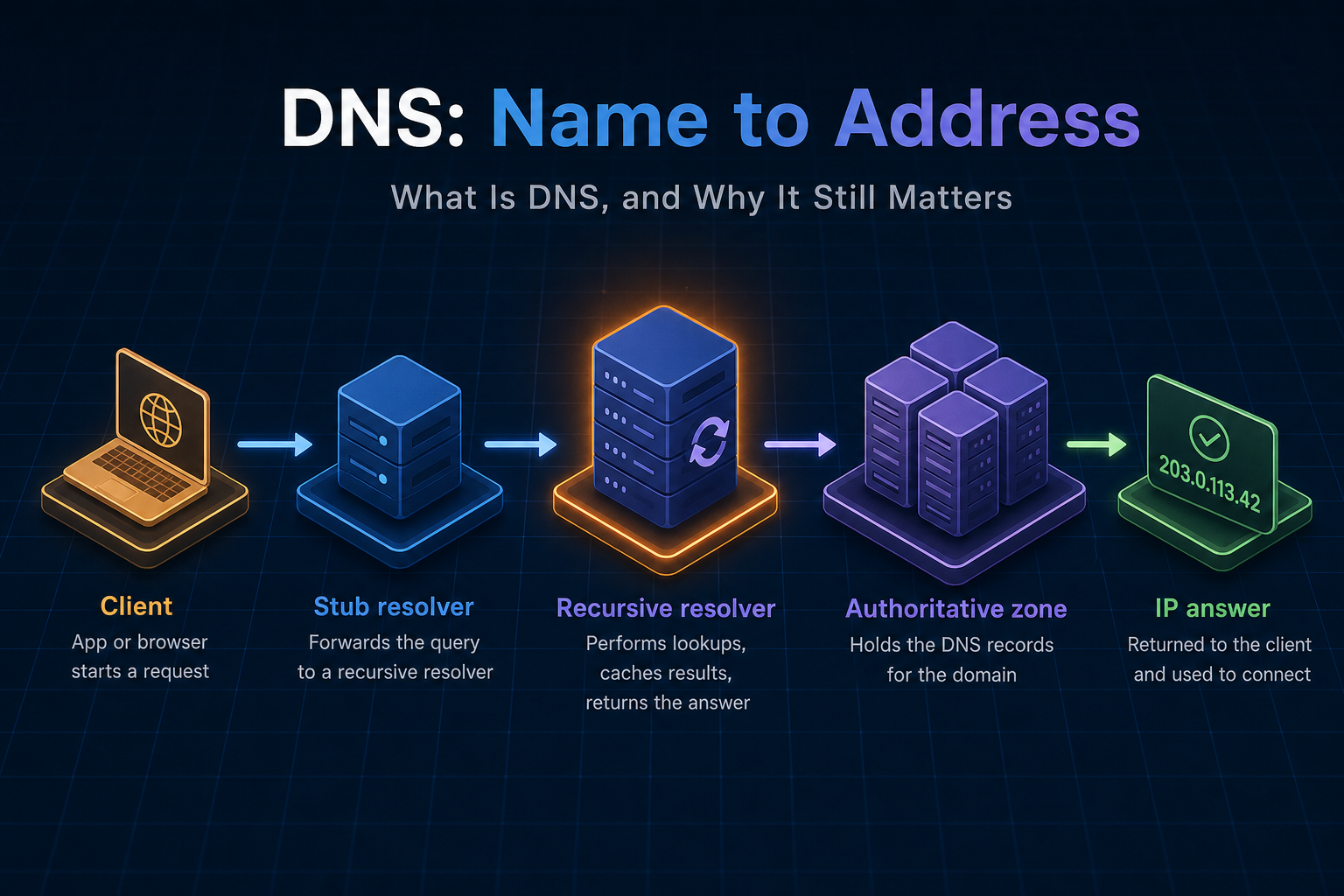
Every time you open a website, send an email, or call an API, one of the oldest distributed systems on the Internet quietly does its job in a few milliseconds.
Most engineers know DNS as the service that converts a domain name into an IP address: google.com → 142.250.66.46. That explanation is correct. It barely scratches the surface.
DNS is not a lookup table. It is a globally distributed, fault-tolerant, hierarchical, eventually consistent database that handles hundreds of billions of queries every day while remaining one of the fastest systems on the Internet.
DNS is one of the largest distributed systems ever built, and it is still on every critical path. It separates identity from location through hierarchical delegation, aggressive multi-layer caching, stateless queries, geographic anycast, and eventual consistency. Cloud and Kubernetes platforms did not replace those ideas. They reused them.
The bottom line first
- DNS maps names to data (addresses, aliases, mail, services), not one giant phone book table.
- One lookup path: stub (device) → recursive resolver → root name server → TLD name server → authoritative name server → IP.
- Scale comes from delegation: each name server knows only enough to point to the next owner.
- Caching at many layers turns millions of user lookups into a handful of authoritative queries.
- TTL is an architecture contract between accuracy and performance.
- UDP, anycast, and eventual consistency keep DNS fast and available; DNSSEC, DoH, and DoT harden it without changing the hierarchy.
What DNS actually is
Without DNS, clients would hardcode location (https://142.250.66.46). Change a server and millions of clients break. DNS separates identity from location: applications know the name; DNS knows where it points. That is the same abstraction behind Kubernetes, Consul, and AWS Cloud Map.
DNS is not one database. The namespace is a tree of zones: root → TLD (.com, .dev) → organisation → host → record. Nobody owns the whole Internet. Partitioned ownership is why it scales.
Components involved
Every public lookup follows the same path:
- Device checks local cache; if missing, asks a recursive resolver.
- Recursive resolver asks a root name server → pointed at the right TLD name server (
.com,.org,.au). - Recursive resolver asks the TLD name server → pointed at the domain's authoritative name server.
- Recursive resolver asks that authoritative name server → gets the IP → returns it to the device.
The stub (your phone, laptop, VM) asks one question: "what is the IP for this name?" It does not know how to chase root → TLD → authoritative. The recursive resolver is the workhorse that does that chase and returns a final answer. Your device talks to one recursive resolver (handed out by DHCP/Wi-Fi, or set manually). That operator varies; the role does not.
| Recursive resolver | Typical address | Who runs it |
|---|---|---|
| ISP / home router | DHCP default (often via 192.168.1.1, then upstream ISP DNS) | Your router or internet provider |
| Cloudflare Public DNS | 1.1.1.1 | Cloudflare (as a resolver, not as your domain host) |
| Google Public DNS | 8.8.8.8 | Google (as a resolver, not as google.com's authoritative DNS) |
| Enterprise / cloud | Corporate DNS, VPC DNS, CoreDNS | Your org or cluster |
Same job in every row: find the answer (cache first, else walk the hierarchy). Different operators mean different privacy, filtering, latency, and geography.
Roles and ownership (the diagram for who talks to whom is in the next section):
| Step | Component | What it does | Where it lives |
|---|---|---|---|
| ① | Stub resolver | Checks local cache; if missing, asks the recursive resolver for a final IP. Does not walk the tree itself. | Your laptop, phone, VM, or container (OS / browser) |
| ② | Recursive resolver | Finds the answer: cache first, then root → TLD → authoritative. Returns the IP and caches it. | ISP DNS, corporate DNS, 1.1.1.1, 8.8.8.8, VPC DNS, CoreDNS |
| ③ | Root name server | Index of all TLDs (.com, .dev, .org, .au, …). Returns only “ask these TLD name servers.” Never knows www… or any website IP. | Public root operators (ICANN / root server system). You do not run these. |
| ④ | TLD name server | Manages an extension (.com, .org, .au, .dev). Points to the domain's authoritative name servers (plus glue IPs). | TLD registries (e.g. Verisign for .com). You do not run these for public TLDs. |
| ⑤ | Authoritative name server | Holds the definitive records for the zone. This is what people usually mean by name server (ns1…). | Domain owner (or their DNS host). For google.com, Google runs ns1.google.com / ns2…. You (or Cloudflare / Route 53 / …) run yours. |
Zone + records are not a sixth network hop. They are the data stored on the authoritative name server (A/AAAA, CNAME, MX, TXT, NS).
- Recursive resolver = hunter on your path that finds the answer (
8.8.8.8, ISP DNS,1.1.1.1). Not the website's DNS. - Authoritative name server = owned/run for that domain. For
www.google.com, that is Google's name servers (ns1.google.com, …). Your stub never talks to them; your recursive resolver does (on a cache miss). - Root and TLD are also name servers, but they only refer ("ask someone else"). The final website IP comes from the domain's authoritative name server.
- Cloudflare dual role:
1.1.1.1is recursive. Cloudflare as your domain's DNS host is authoritative for your zone. Same company, different job.
If the recursive resolver already has www.google.com cached, root → TLD → authoritative are skipped until the TTL expires. The device then connects using the IP. 8.8.8.8 resolving Google is not special: it is the resolver chasing Google's authoritative servers like any other domain.
Delegation: the secret behind scalability
Would one server store hundreds of millions of domains? No. The recursive resolver gets referrals from root and TLD name servers, then the final answer from the domain's authoritative name server. Same chain for a hyperscaler domain or a personal .dev site.
- www.google.com
- www.jitendersharma.dev
"Where is www.google.com?" Root, TLD, and Google's NS never talk to each other. The recursive resolver queries each lane and stitches the answer.
| Hop | Component | What it returns |
|---|---|---|
| ② | Recursive resolver | Starts the chase (after stub cache miss); runs every outbound query |
| ③ | Root name server | "Ask the .com TLD name servers" |
| ④ | TLD name server (.com) | Google's authoritative NS names (ns1.google.com, ns2.google.com) plus glue (their IPs) |
| ⑤ | Authoritative name server (run by Google) | www.google.com → 142.250.x.x |
"Where is www.jitendersharma.dev?" Same lanes. Different TLD (.dev) and Cloudflare as the authoritative name server.
| Hop | Component | What it returns |
|---|---|---|
| ② | Recursive resolver | Starts the chase (after stub cache miss); runs every outbound query |
| ③ | Root name server | "Ask the .dev TLD name servers" |
| ④ | TLD name server (.dev) | Cloudflare NS names + glue |
| ⑤ | Authoritative name server (Cloudflare) | Proxied answer → Cloudflare edge IPs (origin behind the proxy is GitHub Pages) |
Each name server knows only enough to point to the next. That is delegation. Glue records break the chicken-and-egg problem: the recursive resolver cannot reach ns1… without already knowing its IP.
No single machine needs the entire namespace. Storage and operational complexity stay local to each zone owner.
Delegate ownership; do not centralise the catalogue. Hierarchical pointers beat one global table when the namespace is planetary.
How a lookup works
Enter https://www.amazon.com. The stub checks browser / OS cache. On a miss it asks the recursive resolver. That resolver either answers from its cache or walks root → TLD → authoritative (see the swimlane above).
After the first success, later lookups often never leave the ISP or VPC recursive resolver: a million users can collapse into a handful of queries to the authoritative name server.
Every record carries a TTL. Long TTL: fewer queries, slower cutovers. Short TTL: faster failover, more load on the authoritative name server. Match TTL to release policy; it is a product contract, not a random number.
Recursive vs iterative: the stub asks the recursive resolver recursively ("find the answer"). The recursive resolver queries root, TLD, and authoritative name servers iteratively. Hot-path DNS uses UDP/53 for one RTT; TCP is for large answers (DNSSEC, zone transfers).
Speed, consistency, and trust
Anycast makes public recursive resolvers like 1.1.1.1 and 8.8.8.8 appear as one IP while many PoPs advertise it. BGP sends each client to a nearby healthy instance: lower latency and automatic failover without changing stub config.
DNS is eventually consistent. After a change on the authoritative name server, recursive resolvers refresh when TTL expires. Different users can briefly see different answers. That trades immediate global consistency for availability and scale.
Classic DNS assumed a trusting network (poisoning, spoofing, amplification). DNSSEC adds signatures so recursive resolvers can verify records; DoH and DoT encrypt queries from stub to recursive. The hierarchy (root → TLD → authoritative) stays; integrity and privacy improve.
Why it still matters
Cloud and mesh layers multiply names. They do not remove DNS.
| Surface | Why DNS stays critical |
|---|---|
| Hybrid / split-horizon | Same name, different answers from different recursive / authoritative views |
| Failover and cutover | Health checks and TTL on the authoritative name server drive how fast traffic moves |
| TLS | Certificate SANs must match names the stub resolves |
| Microservices / APIs | Hostnames before URLs; resolution failures look like "the app is down" |
| Observability | NXDOMAIN vs SERVFAIL vs wrong answer on the recursive path explain mystery latency |
Principles you reuse elsewhere: partition ownership across zones, delegate through root / TLD / authoritative boundaries, cache at stub and recursive layers, keep requests stateless, route to the nearest healthy endpoint (anycast), accept TTL-bounded staleness, keep identity separate from location. Put DNS on the request path in your observability model the same way you treat load balancers and gateways.
Ask before you ignore DNS: who runs each authoritative name server, which names are public vs private, what the TTL policy is, where recursive resolvers run, and whether incident playbooks distinguish miss, failure, and wrong answer. If you cannot answer, DNS is unowned.
Final takeaway
DNS is often called "the Internet's phone book." Useful for beginners. Incomplete for architects.
A lookup is always the same chain: stub → recursive resolver → root name server → TLD name server → authoritative name server → IP. On top of that sit caching, TTL, anycast, and delegation. Treat DNS as a control plane for names. Design zones, recursive resolvers, and TTL with the same seriousness you give service boundaries. Cloud platforms still depend on it.