What Is an Intent Router — and Why It Matters in Agentic AI

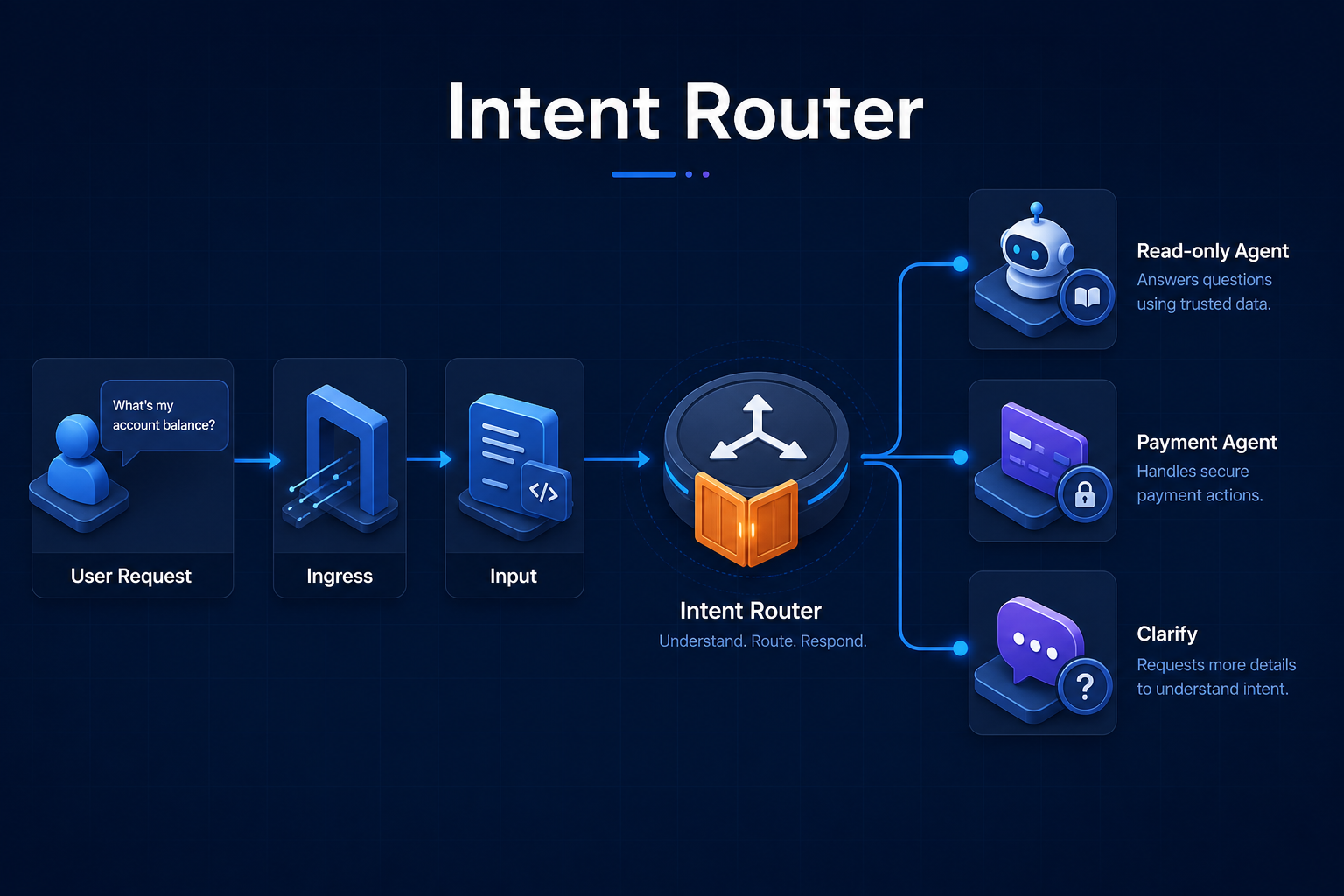
Enterprise teams ship agentic assistants with twenty tools, one system prompt, and a hope the model “figures out what the user wants.” Demos work. Production does not. The failure is rarely reasoning — it is routing: the wrong workflow activated, the wrong tool family exposed, a payment path opened for a read-only question.
An intent router is the architectural component that fixes this. It sits at ingress — after auth and input normalization, before the agent loop — and answers one question deterministically: which governed path should handle this request?
The model proposes; the system routes. Intent classification is not a prompt trick inside the agent loop. It is a platform decision that selects workflow, tool manifest, policy profile, and model path — before any tool schema reaches the LLM.
The bottom line first
- An intent router maps requests to routes — not to answers. It picks which agent, workflow, or tool family should run.
- It is the first gate in the intelligence path. Wrong route means wrong tools, wrong policy, wrong retrieval corpus — even when every later stage “succeeds.”
- Routing belongs in code, not in the loop. The agent planner decides what step next inside a workflow; the router decides which workflow.
- It is evaluable. Unlike open-ended agent behavior, intent labels have golden sets, confusion matrices, and CI gates.
- It is where prediction meets authority. Session context, entitlements, and safety filters constrain which routes are even eligible.
What an intent router actually is
An intent router is a dispatch layer between the user and the agentic app. Given a normalized request (plus session, channel, and identity context), it returns a route contract:
| Output | Purpose |
|---|---|
intent_label | Business-meaningful category (account_history, payment_initiate, policy_qa) |
route_id | Which agent profile or workflow to activate |
confidence | Whether to route, clarify, or abstain |
entities | Structured slots extracted for downstream use |
allowed_tools | Tool manifest scope for this path |
policy_profile | Risk tier, step-up rules, data classification ceiling |
retrieval | Optional. Corpora (scope) and whether the app prefetches (deterministic_prefetch) or the LLM may propose retrieve (tool) |
The router does not plan multi-step execution. It does not call tools. It does not hold credentials. It selects the governed entry point — and the agentic app takes it from there.
This aligns with the Eval Input plane: parsing, intent classification, and first-line safety filters happen before inference begins. If ambiguous intent or injection passes here, no amount of retrieval quality or tool governance will save the outcome.
Why it is a significant architectural component
1. It isolates failure modes
Agent systems fail in layers. When you conflate routing with planning, you cannot tell whether a bad outcome came from:
- wrong workflow selection,
- wrong tool inside the right workflow,
- wrong retrieval,
- or wrong synthesis.
A dedicated router makes intent misroute a first-class failure class — measurable, owned, and fixable without retraining the whole agent.
2. It scopes authority before the LLM sees tools
In Policy-Governed Agent Runtime, the LLM receives conversation and tool schemas only. The agentic app holds the token and forwards proposals to the PEP. Routing decides which schemas appear at all.
A customer asking “show my balance” should never see initiate_wire in the manifest — not because the prompt says “be careful,” but because the router never activated the payment route. This is G.A.I.N Agents in practice: grounding is a pipeline, not a prompt.
3. It makes non-determinism manageable
AI systems map input → many possible outputs. Routing is one place where you can demand repeatable, testable decisions. Your eval suite can assert:
- “Summarize my last three wire transfers” →
account_history - Empty message → clarification, no tool call
- Injection payload → block, no exfil route
That is the same discipline as Eval Plane ①: Input: behavior validated under uncertainty, not just “did it run.”
4. It separates cheap decisions from expensive ones
Routing should be fast. A layered router — rules, classifier, LLM fallback only when needed — keeps latency and cost down while reserving capable models for the agent loop itself. G.A.I.N LLM treats gateway routing as infrastructure: task-aware dispatch, abstention as a first-class outcome, capability matrix per route.
5. It enables multi-agent systems without chaos
When you have specialized agents (support, payments, compliance, internal ops), something must decide which governed path owns the turn. Owns the turn means: for this user message, exactly one route contract is active (workflow, tool manifest, policy profile, and retrieval if applicable) before the agent loop starts.
Without a router, you get:
- every agent loaded with every tool,
- supervisor prompts that grow without bound,
- handoffs that depend on model mood rather than contracts.
Same user, two messages in one session:
| User says | Route owns turn | What activates |
|---|---|---|
| “What’s our wire limit for EU corporate clients?” | policy_qa | Prefetch RAG (deterministic_prefetch), low-risk policy profile, policy corpus. No retrieve tools. |
| “Send $500 to Acme Corp” | payment_initiate | Payment tool manifest, step-up policy profile, PEP on wire tools |
The intent router picks the path; the agent planner picks the next step inside it. Intent routing is strongest when paths split by risk and authority, but it still applies with one agent when manifests differ per turn.
The router is the capability matrix at ingress: task × role × data class → route.
Intent router, agent planner, and model router
Teams collapse three separate decisions into one "routing" step. They should not. Each layer answers a different question on the request path.
| Intent router | Agent planner | Model router | |
|---|---|---|---|
| Question | Which workflow, agent, and tool manifest? | Which step or tool within that workflow? | Which approved model runs this inference call? |
| When | Once per user turn (usually) | Inside the plan → act → observe loop | Per inference call (plan, synthesize, classify) |
| Where | Ingress, before the agent loop | Agentic app / orchestration loop | G.A.I.N LLM gateway |
| Nature | Deterministic + eval-gated | Model-assisted, policy-gated | Capability matrix + registry |
| Output | Route contract (route_id, manifest, policy profile) | Tool proposal | Model endpoint |
| Failure | Intent misroute: wrong tools, corpus, policy | Wrong tool, wrong args, loop runaway | Wrong capability tier, cost, or latency |
| Eval | Intent golden set, confusion matrix | Tool and policy evals in-loop | Per-task quality, canary on model swap |
The intent router runs once at ingress. The agent planner and model router run inside the loop: the planner proposes the next step; the model router picks which endpoint serves each LLM call. An intent router may pin a coarse model_profile on the route (for example, reasoning-standard vs a lightweight chat model). That is a route-level default, not a substitute for gateway routing.
Intelligence in the LLM. Truth in the system. The model may infer intent or propose tools; that is prediction. The intent router's verdict and the PEP gate activate governed paths. The model router scopes which model does the work; the intent router scopes what the system may do.
What happens when you skip it
| Anti-pattern | Production symptom |
|---|---|
| One mega-agent, all tools exposed | Model picks payment tool for a FAQ; PEP denies; user gets confusing errors |
| Routing inside the agent loop | Inconsistent routes across retries; impossible to eval in isolation |
| Prompt-only intent (“figure out what they want”) | Injection hijacks workflow; adversarial inputs reach high-risk tools |
| No confidence threshold | Silent misroutes; wrong corpus retrieved; confident wrong answers |
| No session stickiness | “Yes” after “initiate wire?” re-classified as general chat |
Every row is an architecture failure, not a model failure. The services ran. The model responded. The user still lost trust.
Examiner and operator questions
If you cannot answer these from logs and evals, the router is not production-ready:
- Which route handled this request, with what confidence?
- Which routes were eligible given this user’s entitlements?
- How often does each route misroute on the golden set?
- What happens below threshold — clarify, abstain, or escalate?
- Did a production incident become a permanent regression test?
What comes next
This article defines what an intent router is and why it belongs in the architecture. The companion piece How to Design an Intent Router covers route tables, layered classification, confidence thresholds, eval gates, and wiring into the agentic app. When the question is one runtime with routes vs a split into specialized agents, see One Agent with Routes vs Specialized Agents.
Key takeaways
- Route before the loop: intent selection is a platform decision that picks workflow, manifest, and policy profile, not a prompt trick inside the agent.
- Scope authority at ingress: the LLM should never see tools from routes that were not selected for this turn.
- Eval routing on its own golden set: intent labels, confusion matrices, and CI gates on the Input plane.
- Treat clarify and abstain as first-class outcomes: low confidence should not silently activate high-risk manifests.
- Design next: route table, layered classification, and session stickiness in How to Design an Intent Router.