Before Training an LLM: From Design Dials to a Frozen Shape

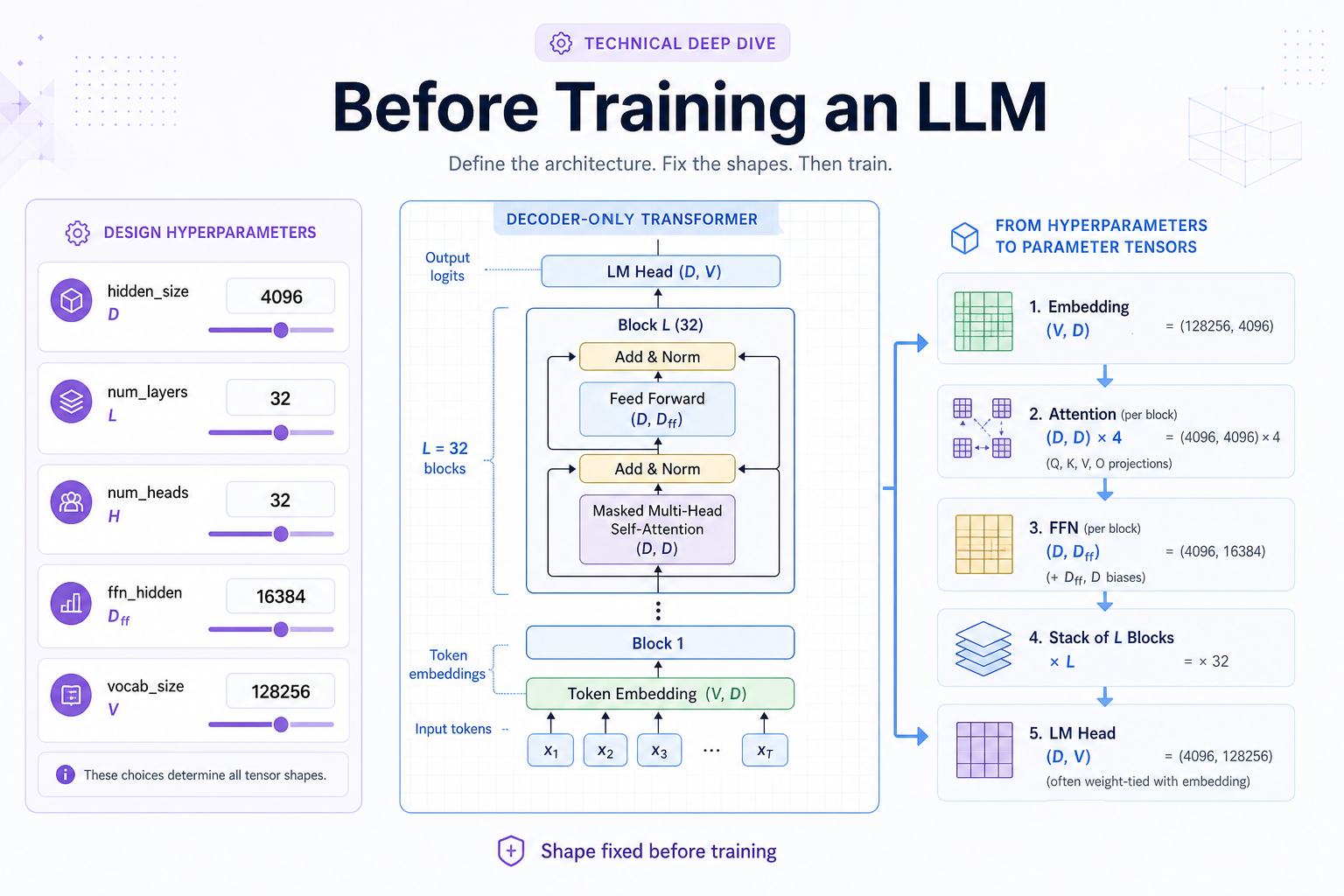
Hyperparameters, vocabulary, and why a 7B model is 7B before day one.
Two things have to be finalised before the model ever sees a single training token:
- The design hyperparameters, the architectural shape of the network.
- The token vocabulary, the dictionary that maps text into the integer ids the model will learn from.
Both are choices a human makes. Once chosen, they are baked into the model and almost never change for the life of that model.
This is a deep dive into Stage 1 of How LLM Works Under the Hood. Training fills in values; alignment shapes behavior; inference runs read-only. This page is everything that must be decided before any of that begins.
A 7B model is 7B because of architectural dials, not because training grew it. Parameter count, tensor shapes, and vocabulary are fully determined before the first forward pass. Training only changes what values the weights hold.
1. Design hyperparameters (fixed at initialization)
These are the architectural dials. They are set once, before any weights are initialised, and they determine how big the model is and how many parameters it will have.
| Hyper parameter | Mental model | What it does |
|---|---|---|
hidden_size (D) e.g. 4096 | How much detail each token carries as it travels through the network, the resolution of an image, or the bandwidth of the bus carrying that token. | The width of every token's representation as it flows through the model. Sets the size of the embedding table (V, D), every attention projection, every residual stream. Bigger D = more capacity per token, more compute per step. |
num_layers (L) e.g. 32 | How many rounds of refinement each token goes through, like passing a draft through 32 editors, each allowed to rewrite based on what the previous one produced. | How many transformer blocks are stacked. Each block re-mixes information across tokens (attention) and re-transforms each token (FFN). More layers = deeper reasoning chains, more compute, more parameters. |
num_heads (H) e.g. 32 | A panel of 32 specialists per layer, each scanning the sentence for a different kind of pattern (grammar, coreference, numbers, etc.) and contributing their finding to the next layer. | How many parallel attention heads per layer. Each head learns to focus on a different relational pattern. More heads = more diverse attention patterns at the same width. |
head_dim (D_h) e.g. 128 (derived: D / H) | The size of each specialist's notebook, how much detail one head can record about its specific pattern. Usually you don't pick this; it falls out of how you split D among H specialists. | The width of each individual attention head. Usually not set directly, it falls out of hidden_size / num_heads. Affects how expressive each head can be. |
ffn_hidden (D_ff) e.g. 16384 | The model's knowledge bank, a wide scratch space inside every block where most of "what the model knows" (facts, patterns, associations) is actually stored. Typically ~4× wider than D. | The intermediate width inside the feed-forward network of every block. Typically 4× hidden_size (or ~3.5× for SwiGLU). This is where most of the model's parameters live. |
vocab_size (V) e.g. 32,000 | The model's alphabet, every distinct piece of text it can read or write. | The number of distinct tokens. Sets the size of the embedding table and the output LM head. Larger V = finer tokenization, bigger embedding and head matrices. |
| Model type e.g. decoder-only transformer | How the model "thinks", a forward-only writer (GPT/Llama) vs a bidirectional reader (BERT). | The architecture family. Decoder-only is the modern standard for LLMs: GPT, Claude, Gemini, Llama. |
| Positional encoding scheme e.g. RoPE, ALiBi, learned absolute | The model's sense of word order, without it, a sentence is an unordered bag of words. | How the model knows token positions. RoPE (rotary) is the modern default; it generalizes better to long contexts than absolute learned positions. |
The model's parameter count is fully determined by these hyperparameters, before training starts.
You can compute the total parameter count from hidden_size, num_layers, num_heads, ffn_hidden, and vocab_size alone. Training does not change how many parameters there are; it only changes what values they hold. A 7B model is 7B because of these dials, not because training "grew" it.
How these dials connect
Each dial below sets the shape of one or more parameter tensors. Count the elements in each tensor, multiply by L where blocks repeat, and sum, that is the model's total parameter count.
| Tensor | Shape | Sized by |
|---|---|---|
| Embedding table | (V, D) | vocab_size, hidden_size |
| Attention (per layer) | 4 × (D, D) | hidden_size, num_heads |
| FFN (per layer) | (D, D_ff) + (D_ff, D) | hidden_size, ffn_hidden |
| LM head | (D, V) | hidden_size, vocab_size |
| Block stack | above block repeated | num_layers |
Worked example: parameter count of a 7B model
Typical 7B-class architecture (Llama-2 scale):
- D = 4096 (hidden size)
- L = 32 (layers)
- H = 32 (attention heads)
- D_h = 128 (head dim, derived: D / H)
- D_ff = 16384 (FFN intermediate)
- V = 32,000 (vocab size)
Walk every parameter tensor, one component at a time.
1. Embedding table
- Shape:
(V, D) = (32000, 4096) - Params: V × D = 32,000 × 4096 = 131 M
2. Attention (per layer)
Each transformer block has 4 projection matrices: W_Q, W_K, W_V, W_O, each shape (D, D).
- Params per layer: 4 × D² = 4 × 4096² = 67 M
- Across L = 32 layers: 32 × 67 M ≈ 2.15 B
3. Feed-forward network (per layer)
Vanilla 2-matrix FFN: expansion (D, D_ff) + compression (D_ff, D).
- Params per layer: 2 × D × D_ff = 2 × 4096 × 16384 = 134 M
- Across 32 layers: 32 × 134 M ≈ 4.29 B
Real models like Llama-2 use SwiGLU, which has 3 matrices instead of 2. Architects compensate by setting D_ff smaller (e.g. 11,008) so total FFN parameter count stays around 4.3 B.
4. LayerNorm
Two LayerNorms per block (pre-attention and pre-FFN), each with scale γ and bias β of shape (D,). Plus one final norm before the LM head.
- Params per layer: 4 × D = 16,384
- Across 32 layers + final norm: ≈ 0.53 M, essentially negligible.
5. LM head (output projection)
- Shape:
(D, V) = (4096, 32000) - Params: D × V = 131 M
If the model uses tied embeddings, the LM head shares weights with the embedding table, saving 131 M parameters.
Total parameter breakdown
| Component | Params | Share |
|---|---|---|
| Embedding | 131 M | ~2 % |
| Attention (32 layers) | 2,147 M | ~32 % |
| FFN (32 layers) | 4,295 M | ~64 % |
| LayerNorm | 0.5 M | ~0 % |
| LM head | 131 M | ~2 % |
| Total | ~6.7 B | 100 % |
That's the famed "7B" model. Production 7B models like Llama-2 7B land at ~6.74 B for almost identical reasons.
FFN dominates (~64 %). That is why architects scale FFN width to add capacity and why Mixture-of-Experts (MoE) models scale the FFN specifically. Attention is significant (~32 %) but often smaller than people assume. Embedding and LM head combined are only ~4 %. LayerNorm is a rounding error.
The context window: how much the model can see at once
The context window is the maximum number of tokens the model can attend to in a single forward pass. It is not a single dial you turn. It emerges from three choices made before and during training:
| Factor | Role in setting the window | Hard cap or soft frontier? |
|---|---|---|
| Positional encoding scheme | Decides whether longer positions are even representable | The gatekeeper |
| Training sequence length | The length the model actually gets good at | Soft, quality degrades past it |
| Attention cost + KV-cache memory | The compute/memory you can afford to serve | The real-world ceiling |
The context window is a budgeted design choice, not a free dial. RoPE/ALiBi set the gatekeeper; training length sets the soft frontier; PI / NTK / YaRN and similar techniques extend RoPE at inference; but O(T²) attention cost and KV-cache memory set what you can actually serve.
Recent LLMs (Llama 3/4, Qwen, DeepSeek, Gemma, GPT, Gemini, Claude) reach 128K-10M tokens by combining these methods, not by flipping one hyperparameter.
2. Create the token vocabulary
Models do not read text. They read integers. Before training, a tokenizer maps those integers to a token vocabulary, the alphabet the model will speak in for its entire life.
Steps
- Prepare a training text corpus, a large, representative sample: web, books, code, multilingual data.
- Choose a target vocabulary size, a human decision balancing coverage vs cost. Typical values: 32k (Llama 2), 50k (GPT-2), 128k (Llama 3), 256k (Gemini).
- Scan the dataset for frequent patterns, BPE (Byte Pair Encoding), WordPiece, or Unigram iteratively merge subword pieces until the target size is reached. This is corpus statistics, not neural learning.
- Finalize the vocabulary, freeze files like
vocab.json,merges.txt, ortokenizer.model. The tokenizer is now a fixed artefact.
Why this matters
You decide the target vocabulary size. The model does not discover vocab_size during training.
By the time training starts, the embedding table shape (V, D) and the LM head shape (D, V) are already fixed because V is known and frozen. Changing the vocabulary after the fact requires resizing the embedding table and effectively re-training the model.
Summary
Before a single gradient is computed, the model is fully described by:
- The shape of every weight tensor, set by design hyperparameters.
- The alphabet the model will speak in, set by the tokenizer.
Pre-training fills in the values. Alignment shapes behavior. Inference navigates a frozen geometry. But the shapes and alphabet stay frozen for the life of that model.
Shape + vocabulary are fixed first. Training only fills the values. A 7B model is 7B because of dials you set on day zero, and most of those parameters live in the FFN, not attention.
Continue the lifecycle: How LLM Works Under the Hood (Stages 2-4). Deep dives: During Training an LLM, Aligning an LLM, After Training an LLM.