Is MCP Really Necessary for Business Agents in Large Regulated Enterprises?

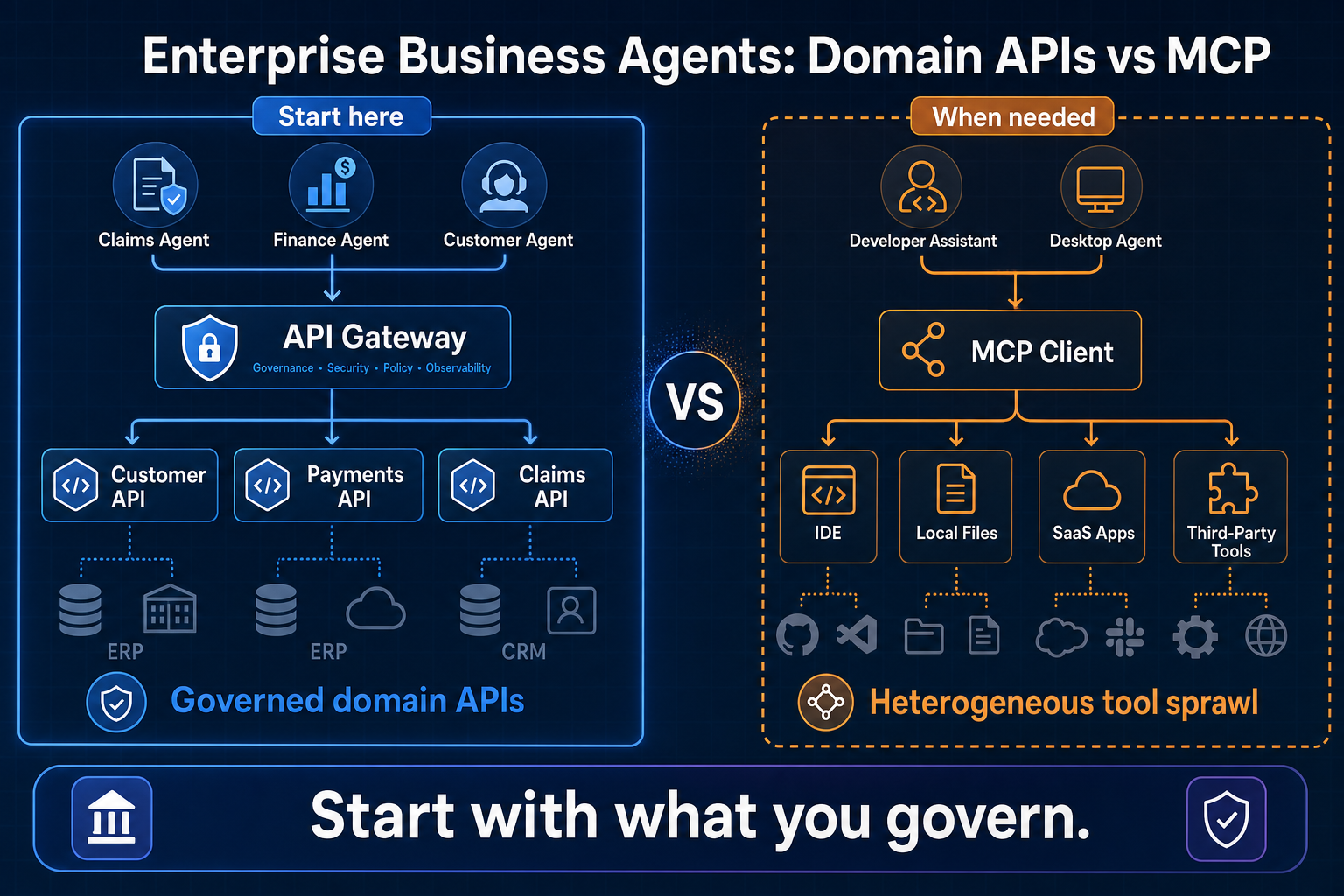
Model Context Protocol (MCP) is an important and promising standard for AI tool interoperability, particularly where agents interact with many heterogeneous tools. Vendors position it as a foundational layer for enterprise agent architectures. That positioning is understandable. MCP solves real problems.
The architectural question for large regulated enterprises is different. It is not whether MCP is good. It is whether MCP's benefits outweigh its operational cost for a particular use case. Business agents in regulated industries typically operate against a relatively small set of well-governed business capabilities already exposed through enterprise APIs. In those environments, MCP should be an implementation choice, not an architectural prerequisite.
This is a decision guide: when governed domain APIs are the right starting point, when MCP earns its cost, and how platform teams can adopt MCP internally without changing the business architecture, building on Policy-Governed Agent Runtime and Design an Intent Router.
MCP is a valuable standard. Adopt it when it demonstrably simplifies the system. Separate agent governance (which agent may call which tools, with which permissions and context) from integration protocol (how a capability is invoked). MCP is one protocol. It is not the architecture for governance. If enterprise APIs already satisfy business agent needs, MCP may not provide enough additional value initially.
The bottom line first
- Governance first, protocol second: which tool, for which agent, with which permissions and context, is an agent/runtime problem, not an MCP Gateway problem.
- Pin a route contract at the intent router: agent identity, tool manifest, policy profile, allowed context, execution shape.
- MCP is good at what it does: standardising AI-facing tool discovery, schemas, resources, and sessions across heterogeneous systems.
- Business agents and developer / external tools differ: governed domain APIs vs vendors without a consistent enterprise API contract.
- Two invocation paths: Agent → governed business API for internal capabilities; Agent → MCP → external vendor/tool when you do not control the API.
- Ask an economic question: does MCP reduce complexity more than it introduces?
- Do not introduce MCP to fix missing agent governance. Fix the route contract and PEP first.
Three questions, one guide
| Section | Answers |
|---|---|
| 1. What MCP standardises | AI-facing interoperability, not REST or governance replacement |
| 2. Business vs developer agents | Route contracts, two invocation paths, different MCP value |
| 3. Economics and adoption | When benefits outweigh cost; platform evolution |
1. MCP is a valid standard, not a substitute for enterprise APIs
MCP is a valuable standard for AI tool interoperability. It standardises how agents discover and invoke tools:
| MCP surface | What it standardises |
|---|---|
| Tool discovery | list_tools across servers with consistent metadata |
| Tool metadata | Names, descriptions, capability boundaries |
| Input/output schemas | Structured arguments and return shapes |
| Resources | Readable context (files, records, configs) |
| Prompts | Reusable prompt templates per server |
| Sessions | Stateful interaction across tool calls |
| Streaming | Incremental results for long-running operations |
MCP does not replace REST, OpenAPI, or enterprise domain APIs. Those remain the governed execution surfaces behind the tools. MCP sits at the AI-facing boundary: how the planner discovers what it can call and how it formats requests.
The argument is narrower and stronger:
If enterprise APIs already satisfy the needs of business agents, introducing MCP may not provide sufficient additional value initially.
That is not a criticism of MCP. It is an application of a timeless enterprise architecture principle: adopt technology when it solves a real problem, not because it is fashionable or expected.
Agent governance: which agent can do what, for whom, using which tools, with which permissions and context?
Integration protocol: how does the agent technically invoke a capability?
MCP is one possible integration protocol. It should not become the architecture for agent governance. Start with the agent contract (route, identity, permissions, tools, context), then pick the simplest invocation path per tool.
2. Business agents and developer agents solve different problems
This is the strongest architectural distinction in the decision.
Developer agents: heterogeneous tool sprawl
Developer and productivity agents typically interact with a large, changing set of unrelated tools:
| Category | Examples |
|---|---|
| Source control | GitHub, GitLab, Bitbucket |
| Collaboration | Slack, Teams, email |
| Work tracking | Jira, Linear, Azure DevOps |
| IDEs and local | VS Code, local files, terminals |
| Infrastructure | Kubernetes, cloud consoles, Terraform |
| SaaS | Hundreds of third-party products |
MCP's benefits are often much greater here: one protocol over highly heterogeneous systems, consistent discovery, and a growing ecosystem of MCP servers.
Business agents: governed business capabilities
Business agents in regulated enterprises typically invoke a relatively small, stable set of governed capabilities:
| Capability | What the agent does |
|---|---|
| Customer | Lookup, update, entitlements |
| Claims | Intake, status, adjudication triggers |
| Payments | Validate, initiate, reconcile |
| Orders | Create, modify, fulfil |
| Pricing | Quote, discount rules, approval |
These capabilities already expose REST APIs, OpenAPI contracts, OAuth, audit logging, monitoring, and lifecycle management through enterprise gateways. Business applications consume them today. A Claims Agent calling the Claims API is not a new pattern. It is the same governed consumer with a planner in front.
| Dimension | Business agents | Developer agents |
|---|---|---|
| Tool count | Small, stable set of domain APIs | Large, heterogeneous, frequently changing |
| Governance | PEP + domain auth (PGAR) | Tool exposure controls, server registry |
| Schema source | OpenAPI in API catalog | MCP list_tools / server manifests |
| MCP value | Often lower initially | Often high |
| Default path | Capability registry + domain APIs | MCP often justified early |
Business agents should think in capabilities, not products
| Agent | Should call | Should not know |
|---|---|---|
| Claims Agent | Claims API | SAP, Guidewire, or whichever claims platform runs underneath |
| Customer Service Agent | Customer API | Salesforce, ServiceNow, or CRM product name |
| Finance Agent | Payments API | Payment provider, core banking product, or wire hub vendor |
| Inventory Agent | Inventory API | Which ERP stores stock levels |
An intent router maps requests to business routes (Claims, Customer, Payments), not vendor names. Treat the route as an agent contract for that request. Pin it before the agent loop starts. This mirrors Retrieval is a governed action: the agent proposes; governance decides.
| Contract field | Meaning | Typical artifact |
|---|---|---|
| Agent identity | Which runtime or agent profile owns the turn | Route / agent profile on the route row |
| Tool manifest | Which tools or APIs this turn may use | tool_manifest |
| Permissions | What the agent is authorised to do | policy_profile + PEP/PDP (PGAR) |
| Context | What data and corpora the agent may access | retrieval (mode + scope), entitlements, session claims |
| Execution policy | How the workflow may run (one call, fixed stages, open loop) | Workflow / autonomy pattern (Agents Blueprint) |
Once the route is pinned, the agentic app operates inside that contract. The governance boundary sits around the agent and its execution context, not in an MCP Gateway that rediscovers tools after the fact.
Two invocation paths
The presence of an agent does not mean every downstream capability must become an MCP tool. Choose the simplest path that preserves the contract:
| Path | Shape | When |
|---|---|---|
| Internal | Agent → governed business API | Mature enterprise APIs already exist (Claims, Customer, Payments) |
| External | Agent → MCP → vendor / third-party tool | You do not control a consistent enterprise API contract |
For many regulated enterprises with established API and integration patterns, standing up an MCP Gateway + MCP Server for every internal business capability adds discovery, auth, session, observability, and versioning concerns that the domain APIs already handle. Prefer Agent → governed business API there. Reserve MCP for external or heterogeneous surfaces where a standard AI-facing protocol earns its keep.
3. The economic question: does MCP reduce complexity more than it introduces?
Rather than asking "Should we use MCP?", ask "Does MCP reduce complexity more than it introduces?"
Every new platform layer brings measurable cost:
| Cost area | What you inherit |
|---|---|
| Security reviews | New attack surface, server sprawl, tool exposure |
| Monitoring | Traces, quotas, server health, version drift |
| Support | On-call, incident response, capacity planning |
| Upgrades | Protocol versions, server compatibility |
| Governance | Policy gates, audit trails, entitlement mapping |
| Skills | Teams learn MCP alongside existing API governance |
| Operational ownership | Who runs the gateway, registry, and server fleet? |
These costs should be justified by measurable benefits: reduced integration time, fewer bespoke adapters, lower schema drift, or OpenAPI gaps MCP fills better than alternatives.
AI observability in enterprise applies the same discipline: instrument what matters, not every possible signal. MCP adoption deserves the same rigour.
Common mistakes
| Mistake | Why it hurts |
|---|---|
| MCP as architectural prerequisite for all agents | Cost lands before integration pain is measurable |
| Hanging governance on an MCP Gateway | Tool allowlists, permissions, and context belong on the route contract and PEP, not rediscovered at a protocol gateway |
| Introducing MCP to fix missing agent governance | Protocol does not answer which agent may call which tool; pin the route contract first |
| Treating MCP as a REST replacement | Domain APIs remain the governed execution path |
| One pattern for business and developer agents | Different integration profiles deserve different defaults |
| Agents calling vendor SaaS directly | Bypasses gateway, audit, and policy |
| Treating MCP as governance | Protocol standardises invocation; it does not replace PEP or domain auth |
| MCP Server per internal business capability by default | Often duplicates existing API governance; prefer governed business APIs when they already work |
| Future-proofing without a trigger | Operational cost is real; benefit is hypothetical |
4. MCP inside the platform, not in the business architecture
Even if business agents call domain APIs directly today, platform teams may adopt MCP internally without changing what business teams experience.
Today:
Platform evolution (MCP as internal implementation):
Business teams do not necessarily need to care which protocol the platform uses internally. What they need is a stable capability registry, governed tool manifests, and policy enforcement before execution. MCP becomes a platform engineering choice, not a business architecture mandate.
5. Introduce MCP deliberately
A pragmatic adoption path:
Phase 1: Capability registry and domain APIs
Business agents discover capabilities through a registry and invoke governed domain APIs. Register OpenAPI specs as tool manifests. Route through the existing gateway. Enforce policy at the PEP. This is the default for regulated business agents.
Phase 2: Measure integration pain
Track where integration cost actually lands: adapter count, schema drift, discovery overhead, OpenAPI gaps, or server sprawl. The trigger for MCP is demonstrated pain, not vendor momentum or industry expectation.
Phase 3: MCP where value is demonstrated
Introduce MCP where it demonstrably simplifies the system: external vendors without a consistent enterprise API, developer tooling, cross-vendor SaaS sprawl, platform-internal standardisation, or thin OpenAPI coverage. Business agents on governed domain APIs may never need to traverse MCP directly.
Separate agent governance from integration protocol. Start with the route contract (identity, tools, permissions, context, execution policy). Then choose the simplest invocation path per tool. Introduce MCP when it simplifies that path, not to compensate for missing governance, and not simply because the standard exists.
Key takeaways
- Governance before protocol: which agent, which tools, which permissions and context is a runtime problem; MCP is one way to invoke a capability.
- Pin a route contract at the intent router; run the agentic app inside that contract, not behind a rediscovery gateway.
- MCP is a valuable standard for AI tool interoperability; the question is fit and economics, not validity.
- Prefer Agent → governed business API for mature internal capabilities; use Agent → MCP → vendor when you lack an enterprise API contract.
- Ask whether MCP reduces complexity more than it introduces: security, monitoring, support, upgrades, governance, skills.
- Do not introduce MCP to solve a problem that should have been solved by agent governance first.
- Platform teams may adopt MCP internally while business teams continue to see capability registries and domain APIs.