Aligning an LLM: From Autocomplete to Assistant

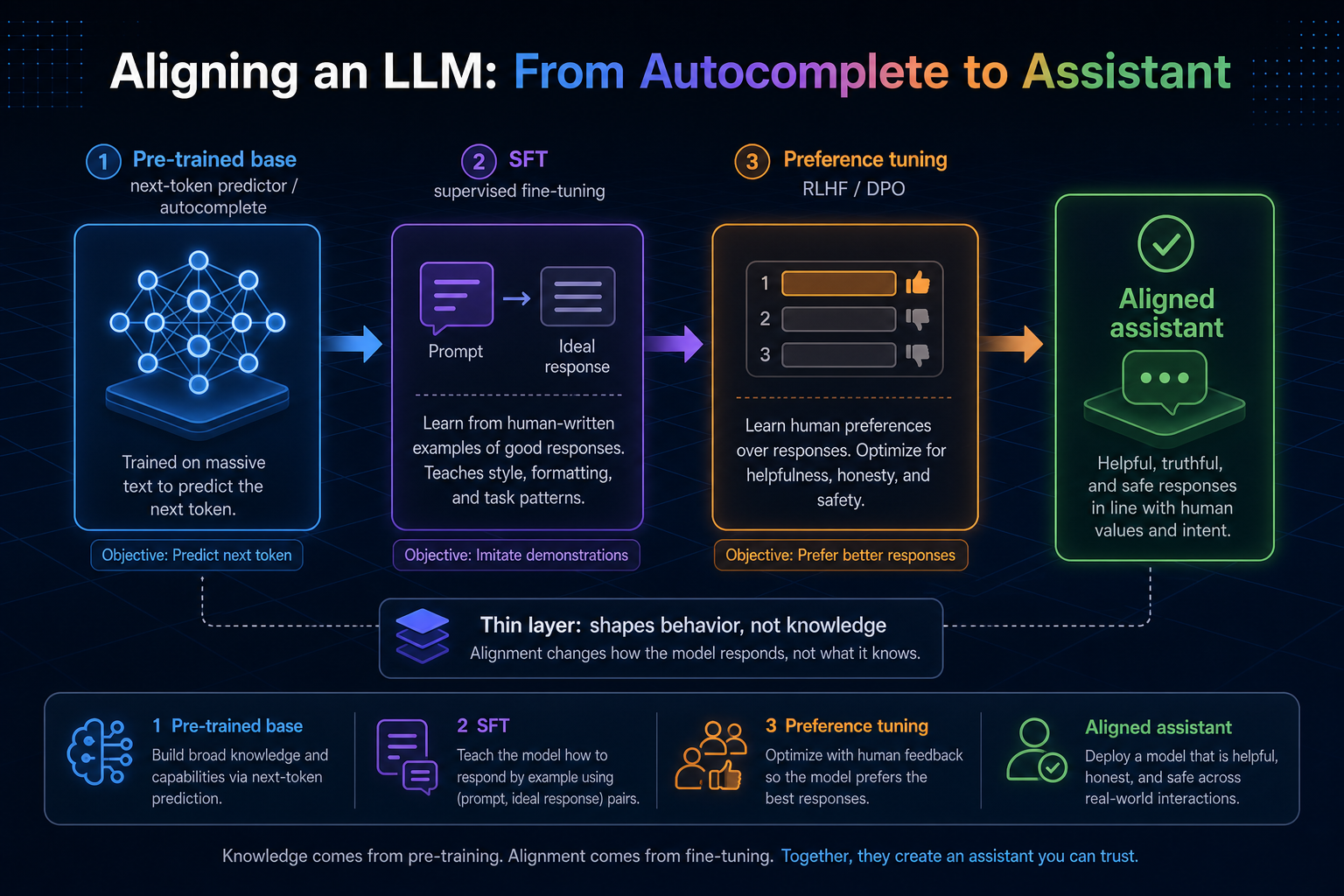
Pre-training grows a model that predicts the next token extremely well. That is not the same as a helpful assistant. A raw base model will continue any prompt, mimic toxic text, or ignore an instruction when a more statistically likely continuation wins.
Alignment is the stage that reshapes that behavior. It still updates weights with the same four-step loop (forward, loss, backprop, optimizer), but with different data, a different objective, and far fewer steps. The result is the chat-style model you actually ship.
This is a deep dive into Stage 3 of How LLM Works Under the Hood. It follows During Training an LLM, which covers how pre-training fills the weight tensors, and precedes After Training an LLM, which covers frozen inference.
Alignment is still training, but it is a thin layer on top of pre-training. It shapes behavior (instruction-following, helpfulness, refusals). It does not pour in the knowledge. Almost everything the model knows came from the base pre-training run.
Why pre-training is not enough
By the end of pre-training, each component has settled into its role: embeddings encode meaning, attention routes context, FFNs transform, LayerNorm stabilises. The model is a strong next-token predictor over internet-scale text.
What it has not learned:
| Capability | Pre-trained base | Aligned assistant |
|---|---|---|
| Continue text fluently | Yes | Yes |
| Follow an instruction as a task | Unreliable | Expected |
| Prefer helpful, clear answers | No explicit preference | Tuned |
| Refuse harmful requests | No | Tuned |
| Stay in assistant format | No | Tuned |
A base model optimises one thing: p(next token | context). An assistant needs a second job on top of that: given a user prompt, produce a good response, not just a plausible continuation of the prompt string.
Same loop, different job
Alignment does not invent a new training algorithm. It reuses the loop from pre-training:
- Forward pass
- Compute loss
- Backpropagation
- Optimizer step
What changes:
| Dial | Pre-training | Alignment |
|---|---|---|
| Data | Trillions of tokens of raw (or lightly filtered) text | Thousands to millions of curated examples or preference pairs |
| Loss focus | Every token in the sequence | Often response tokens only (SFT), or a preference / reward objective |
| Steps and cost | Weeks/months, enormous compute | Short, comparatively cheap |
| What improves | Knowledge, fluency, latent skills | Behavior, format, preference |
The architecture dials and vocabulary stay frozen from Before Training an LLM. Alignment only changes values inside those tensors, and only a little compared with pre-training.
Stage 1: supervised fine-tuning (SFT)
Train on curated (prompt, ideal response) pairs written or vetted by humans (or strong models). The loop matches pre-training with one important change: the loss is computed on the response tokens, so the model learns to produce good answers rather than merely continue the prompt.
What SFT teaches:
- When asked a question, answer it
- When asked for a list, produce a list
- Stay in assistant voice and format
- Rough instruction-following
Dataset size is typically thousands to a few million examples, versus trillions of tokens in pre-training. After SFT the model behaves like an assistant, but its sense of which answer is best among several plausible ones is still rough.
Stage 2: preference tuning (RLHF / DPO)
Humans (or a model) rank competing responses to the same prompt. That preference signal pushes the model toward the preferred kind of answer.
Two common recipes:
- RLHF: train a separate reward model to score responses, then use reinforcement learning (often PPO) so the LLM maximises that score while staying close to the SFT policy.
- DPO (and variants): skip the separate reward model and optimise directly on preference pairs with a classification-style loss. Simpler, and now very common.
This stage shapes helpfulness, tone, and harmlessness. It is why a model refuses dangerous requests and prefers clear, well-structured answers.
Variants such as RLAIF (AI feedback instead of human labels) or constitutional-style rule sets are the same idea: a preference or principle signal, not a second internet-scale pre-train.
Alignment is a thin layer
| Main training (pre-train) | Polish (alignment) | |
|---|---|---|
| Data | Trillions of words | Thousands to millions of examples |
| Length / cost | Weeks/months, huge cost | Short, cheap |
| What it does | Teaches knowledge | Shapes behavior |
Alignment still changes weights, but typically with a tiny dataset, a small learning rate, and few steps (often with parameter-efficient methods like LoRA that update only a slice of the weights). It mostly elicits and shapes behavior the base model already latently has. It does not replace pre-training as the source of capability.
If the base model never saw the underlying skill in pre-training, alignment rarely invents it. Alignment is how you steer what is already there.
What this means for architects
| Question | Mostly answered by |
|---|---|
| Does the model know enough about my domain? | Pre-training (and later domain fine-tunes / RAG), not alignment alone |
| Will it follow instructions and stay in format? | SFT |
| Will it prefer safe, helpful answers? | Preference tuning |
| Why is the chat model different from the base download? | Alignment stages on top of the same architecture |
| Where did most of the $ go? | Pre-training |
Product choice often looks like "base vs instruct/chat." That label is largely this stage: same frozen shape from Before, knowledge from During, behavior from Align.
Handoff: freeze and ship
After alignment the weights are shipped and locked. No optimiser, no loss, no backward pass at serve time. Everything from here is read-only inference: prefill, decode, sampling, KV cache.
Deep dive: After Training an LLM: From Frozen Weights to Token-by-Token Inference.
Final takeaway
Pre-training grows knowledge into the tensors. Alignment is a short second training phase that turns a next-token predictor into an assistant: SFT for format and instruction-following, preference tuning (RLHF/DPO) for which answers are better. For architects, keep the split clear: quality of knowledge and most of the cost live in pre-training; product behavior, refusals, and "chat vs base" live in alignment.